
How to use ICD-10 and OPCS-4 breakdowns
Source:vignettes/how-to-use-breakdowns.Rmd
how-to-use-breakdowns.RmdOverview
Breakdowns allow you to go beyond total usage counts and explore how ICD-10 and OPCS-4 codes are used across different patient groups and clinical contexts. For more information on all datasets available in this package see the available datasets vignette.
- Position: Describe the count of main diagnosis (vs all dignoses) for inpatient treatment and the main procedures (vs all procedures) recorded for each available code;
- Sex: female, male, and gender unknown;
- Age: mostly 5-year age groups from 0 to 90 plus.
See the full list of ICD-10 breakdowns in the results below. The same
breakdowns are available for OPCS-4, but the position breakdowns are
called all_procedures and main_procedure
instead.
icd10_usage_breakdowns <- get_hesapc_icd10_breakdowns()
#> ℹ Downloading "hesapc_icd10_breakdowns" (v0.1.0)
#> ✔ Downloading "hesapc_icd10_breakdowns" (v0.1.0) [438ms]
#>

# Available breakdowns for ICD-10
unique(icd10_usage_breakdowns$breakdown)
#>  [1] "all_diagnoses"  "main_diagnosis" "male"           "female"
#>  [5] "gender_unknown" "age_0"          "age_1_4"        "age_5_9"
#>  [9] "age_10_14"      "age_15"         "age_16"         "age_17"
#> [13] "age_18"         "age_19"         "age_20_24"      "age_25_29"
#> [17] "age_30_34"      "age_35_39"      "age_40_44"      "age_45_49"
#> [21] "age_50_54"      "age_55_59"      "age_60_64"      "age_65_69"
#> [25] "age_70_74"      "age_75_79"      "age_80_84"      "age_85_89"
#> [29] "age_90plus"
Worked examples
In these examples we’re exploring the code usage for the ICD-10 code F90.0 (Disturbance of activity and attention), which is used to record Attention Deficit Hyperactivity Disorder (ADHD). The underlying data structure looks like this:
icd10_adhd_breakdowns <- icd10_usage_breakdowns |>
  filter(icd10_code == "F900")

icd10_adhd_breakdowns
#> # A tibble: 377 × 6
#>    start_date end_date   icd10_code description                 breakdown  usage
#>    <date>     <date>     <chr>      <chr>                       <chr>      <int>
#>  1 2024-04-01 2025-03-31 F900       Disturbance of activity an… all_diag… 121645
#>  2 2024-04-01 2025-03-31 F900       Disturbance of activity an… main_dia…    287
#>  3 2024-04-01 2025-03-31 F900       Disturbance of activity an… male       58670
#>  4 2024-04-01 2025-03-31 F900       Disturbance of activity an… female     62059
#>  5 2024-04-01 2025-03-31 F900       Disturbance of activity an… gender_u…    916
#>  6 2024-04-01 2025-03-31 F900       Disturbance of activity an… age_0          2
#>  7 2024-04-01 2025-03-31 F900       Disturbance of activity an… age_1_4      539
#>  8 2024-04-01 2025-03-31 F900       Disturbance of activity an… age_5_9     6869
#>  9 2024-04-01 2025-03-31 F900       Disturbance of activity an… age_10_14  12908
#> 10 2024-04-01 2025-03-31 F900       Disturbance of activity an… age_15      3451
#> # ℹ 367 more rows
Calculating the percentage of main diagnosis coding
Calculating what proportion of usage is recorded as a main diagnosis helps distinguish between codes used to describe the primary reason for admission and those capturing co-existing conditions.
adhd_diag_positions <- icd10_adhd_breakdowns |>
  filter(breakdown %in% c("all_diagnoses", "main_diagnosis")) |>
  group_by(icd10_code, description, breakdown) |>
  summarise(n = sum(usage), .groups = "drop") |>
  pivot_wider(names_from = breakdown, values_from = n) |>
  mutate(pct_main_diagnosis = round(main_diagnosis / all_diagnoses * 100, 2))

adhd_diag_positions
#> # A tibble: 1 × 5
#>   icd10_code description         all_diagnoses main_diagnosis pct_main_diagnosis
#>   <chr>      <chr>                       <int>          <int>              <dbl>
#> 1 F900       Disturbance of act…        538927           3610               0.67
Only 0.67% of F90.0 coding is recorded as the main diagnosis, indicating that ADHD is typically recorded as a co-existing condition and not the main condition being treated.
Visualising trends in sex breakdowns
# Define all x axis breaks
x_breaks <- unique(icd10_adhd_breakdowns$end_date)

# Create figure for sex breakdowns
fig_adhd_sex_breakdowns <- icd10_adhd_breakdowns |>
  filter(breakdown %in% c("male", "female", "gender_unknown")) |>
  ggplot(aes(x = end_date, y = usage, colour = breakdown, shape = breakdown)) +
  geom_line(alpha = .3) +
  geom_point(size = 2) +
  scale_y_continuous(labels = label_number(accuracy = 1)) +
  scale_x_date(breaks = x_breaks, labels = label_date("%b\n%Y")) +
  scale_colour_viridis_d(end = .7, option = "C") +
  labs(x = NULL, y = "Usage count", colour = NULL, shape = NULL)

fig_adhd_sex_breakdowns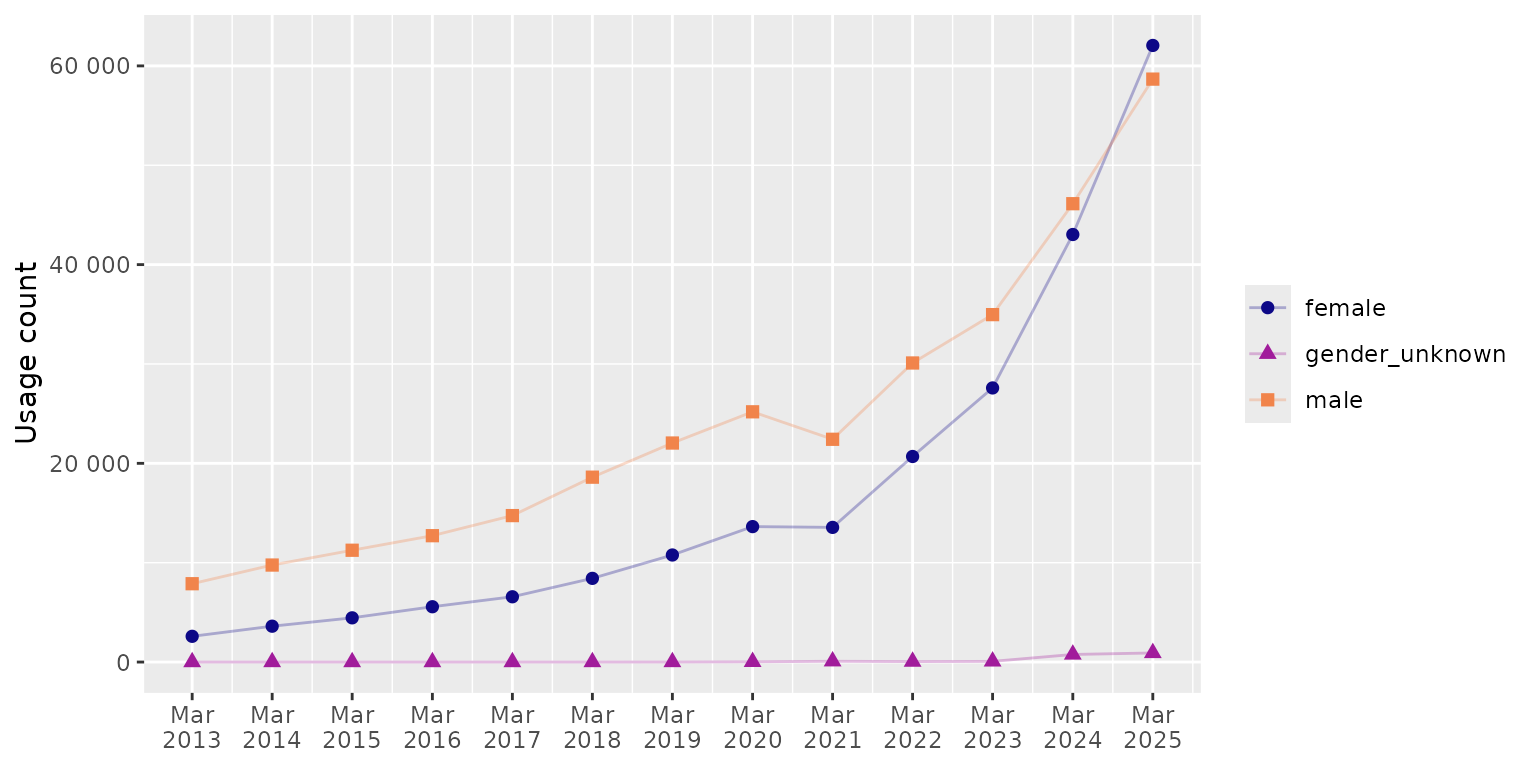
Trends in ICD-10 code F90.0 (Disturbance of activity and attention) usage by sex in England.
Visualising trends in age breakdowns
# Define short x axis breaks (only every 4th reporting period)
x_breaks_short <- x_breaks[seq(1, length(x_breaks), by = 4)]

# Create figure for age breakdowns
fig_adhd_age_breakdowns <- icd10_adhd_breakdowns |>
  filter(str_starts(breakdown, "age")) |>
  mutate(breakdown = reorder(breakdown, parse_number(breakdown))) |>
  ggplot(aes( x = end_date, y = usage, colour = breakdown)) +
  geom_line(alpha = .3) +
  geom_point() +
  scale_y_continuous(labels = label_number(accuracy = 1)) +
  scale_x_date(breaks = x_breaks_short, labels = label_date("%b\n%Y")) +
  scale_colour_viridis_d(end = .75) +
  labs(x = NULL, y = "Usage count",colour = NULL, shape = NULL) +
  theme(legend.position = "none", panel.spacing = unit(.4, "cm")) +
  facet_wrap(~breakdown, ncol = 4)

fig_adhd_age_breakdowns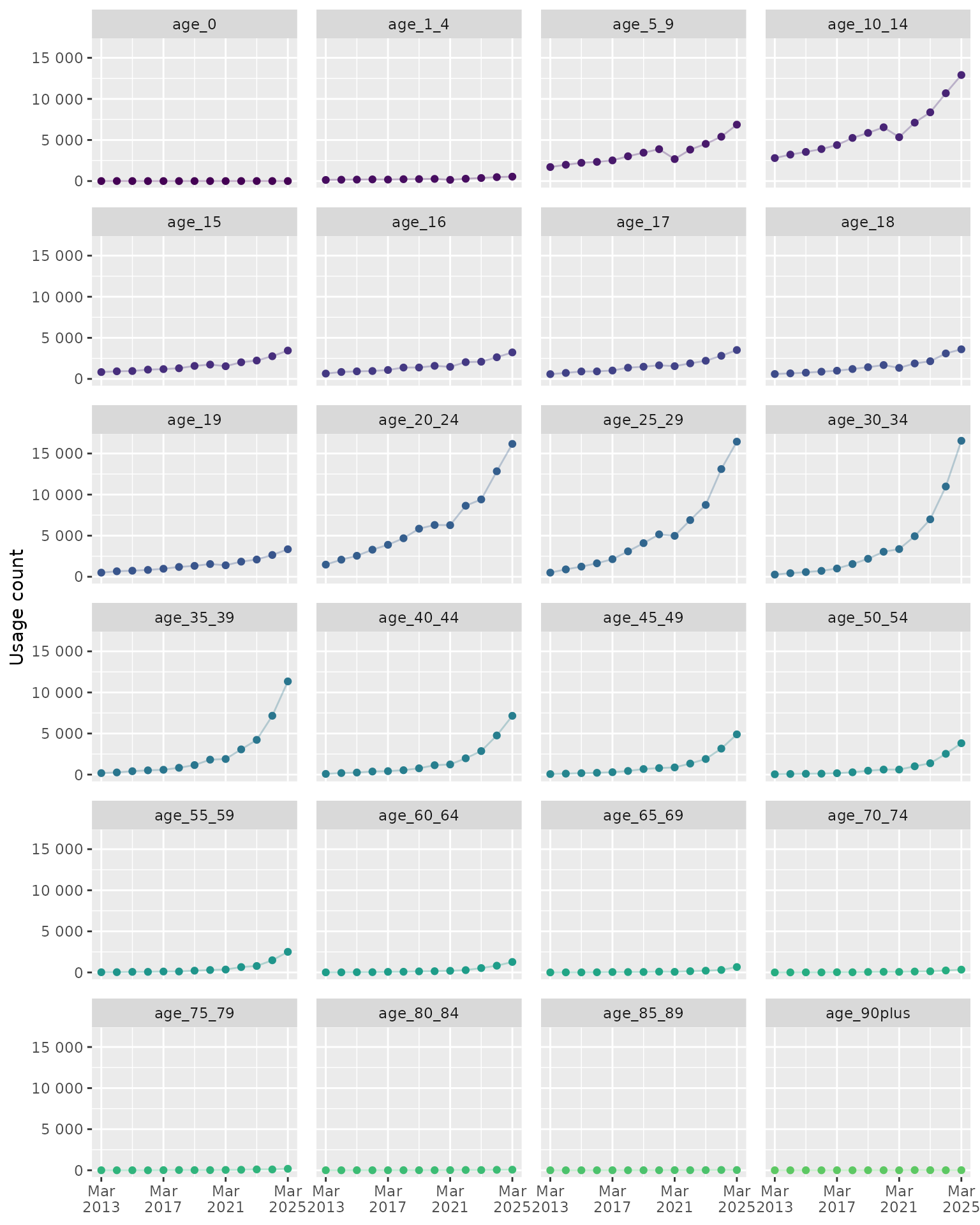
Trends in ICD-10 code F90.0 (Disturbance of activity and attention) usage by age group in England.